Sunday, October 03, 2010

Persevere: Look ahead: Be optimistic. It pays!

I’m taking a leaf out of SomeBeans’ book and using a blog post to write a reminder of a book I’ve just read. The book in question is ‘A Pioneering Plantsman – A K Bulley and the Great Plant Hunters’ by Brenda McLean, courtesy of Chester library.

Over the past 12 months I’ve read several books about the great plant hunters and the trials they endured to bring new species (and even new genera) of plants to the attention of the British gardener. If you’re interested in this subject, there can’t be a much better illustration of the dangers and privations that plant hunters suffered than the biography of David Douglas – the man who brought the Douglas-Fir (Pseudotsuga menziesii) into cultivation. Although this tree commemorates Douglas’s successful seed saving in its common name, its Latin name celebrates its discoverer, Archibald Menzies. If you’re interested in reading about Douglas and his arduous (and ultimately fatal) plant hunting expeditions, I’d recommend this book.

But what of the people who financed these expeditions? They did not have to put themselves through the dangers of hunting out the plants, but without their backing our gardens would have been a lot poorer. Perhaps one of the most famous backers of plant hunters in the Victorian time was the Veitch Nursery of Exeter and Chelsea. This link gives some information on the Veitch Nursery, and this one lists some of the introductions of plants by plant hunters employed by the Veitches – an impressive list which includes the beautiful Davidia involucrata, the seeds of which were collected by E H ‘Chinese’ Wilson, one of their most famous hunters.

IMG_5936 Davidia involucrata (growing at Bodnant Gardens)

A less well-known sponsor of plant hunting in the early 1900’s was A K Bulley. Born in 1861 to a cotton merchant family in Liverpool, Bulley developed an early love for natural history and plant cultivation. He was a committed socialist, standing unsuccessfully as a Parliamentary candidate in three elections, including as a Women’s Suffrage candidate.

In 1897, Bulley bought some land at Ness, on the Wirral peninsula, where he built a house, Mickwell Brow, and started to develop the gardens. From the start, the gardens were freely open to the public between dusk and dawn, every day except Christmas Day. The gardens are still open to the public now, (although not freely!) after being gifted to the University of Liverpool by his daughter in 1948.

Bulley started a commercial nursery in the gardens in 1904 – Bees Ltd., as well as continuing his cotton trading.  The title of this post comes from a Bees’ advertisement. The nursery sold seeds of all types of plants, many of which were displayed in the extensive herbaceous borders at Ness. However, Bulley’s main interest throughout his life was in alpine plants.

IMG_6726

In the early 1900’s, the cotton trade was doing well, so Bulley felt that he had sufficient funds to be able to support a plant hunter to expand his plant collection. In correspondence with Sir Isaac Balfour, of the Royal Botanic Garden of Edinburgh, the name of George Forrest was recommended. And so Forrest was sent to North west Yunnan, China. This area was decided upon as it was not quite on Veitch’s and Wilson’s stamping ground, but would supply the alpine and hardy herbaceous plants which Bulley craved both for his own interests and for his business interests. New introductions of seed could command high prices.

Forrest was subjected to difficult conditions and hostility, as well as the vagaries of Bulley’s purse strings. However, he discovered large numbers of new plants, and collected their precious seeds. Pieris formosa forrestii was discovered by Forrest, and a plant from the original seed still grows at Ness. As the Bees nursery grew, Bulley recognised the opportunity for advertising his nursery through the names of newly discovered plants, and so introduced Primula beesiana, Jasminium beesianum and Allium beesianum. Bulley himself is commemorated in many plant names, including Primula bulleyana (candelabra primula) and Androsace bulleyana. Forrest also collected seed of the previously discovered Primula viallii.

IMG_8585

 Primula viallii growing at Ness Gardens

Bulley continued to support Forrest’s expeditions for several years, despite Forrest’s concerns about payment – Bulley on occasions left Forrest without sufficient funds.

Another plant hunter supported by Bulley was Frank Kingdon-Ward. This was a man who loved the adventurous life of an explorer, but wasn’t quite as systematic in his plant-hunting as Forrest, which sometimes frustrated Bulley. Neverthless, Kingdon-Ward provided seed of many species new to cultivation which were subsequently sold by Bees. These included Gentiana wardii, Primula chungensis and Rhododendron wardii. Kingdon-Ward went on to collect seed from many rhododendron species in China, such as Rhododendron lanigerum.

IMG_4848 Rhododendron lanigerum at Ness Gardens.

Moving on from China, Bulley was looking to the Himalayas, and employed a young collector called R E Cooper. Cooper busily collected alpine plants from Sikkim, but to Bulley’s dismay these high alpine specialists were almost impossible to grow in the UK, and those that did grow were not marketable enough to make a profit. Cooper’s second trip for Bulley was to the ‘hidden kingdom’ of Bhutan, where he discovered plants such as Cotoneaster cooperi and Viburnum grandiflorum. However, Cooper’s finds were generally of more interest to botanical science than as plants to grow in a garden, and Bulley never recouped in sales the amount of money that Cooper’s expeditions cost.

With the onset of the First World War, Bulley reduced his sponsorship of plant hunters, though he had a part share in Reginald Farrer’s expedition to China. After the war, Farrer set off to Burma, where he found the beautiful Nomocharis farreri. There was tension between Bulley and Farrer, as Farrer was of gentrified stock as opposed to Bulley’s merchant background, and Farrer did not enjoy being beholden to Bulley’s rather stingy and often late financial support. Farrer unfortunately died and was buried in the Burmese hills whilst collecting.

Still obsessed with alpines, Bulley also supported exploratory expeditions to the areas surrounding Mount Everest, providing money for the expedition  in return for seed collecting. A range of new rhododendrons were collected, as well as a new primula – Primula wollastoni, named after the naturalist on the expedition, Dr A F R Wollaston.

With his obsession for rare and beautiful alpine plants, Bulley was always looking for new ways of growing his precious collection. This led to an experiment which caused a backlash in the press of the time, and something which we would consider very bad form nowadays. Bulley had seen the alpine gardens which have been made on some mountains in the Alps, and thought that they could be emulated in the UK.

P7180036 Podophyllum hexandrum (from the Himalayas) growing in the Alpenblumengarten on Kitzbuheler Horn.

He rented 500 acres of land on Mount Snowdon in Wales and planted up a range of alpines, many of which had been discovered by his plant hunters. His idea was to naturalise and experiment with exotics in the wild. He was aware that there might be concern over this, but knew that the plants were temperamental and very unlikely to escape from the ‘garden’ and outcompete native plants. However, the press exaggerated the scale of his experiment, and the negative publicity associated with the scheme, as well as poor survival rates of the plants, meant that he eventually had to abandon it. Bulley continued to support plant hunters, though now as one of a number of subscribers rather than the sole sponsor.

After his death his daughter, Lois Bulley, gifted Ness Gardens to the University of Liverpool, who still own it. Nowadays it is a botanic garden, still containing many of the plants that were grown from seed by Bulley’s gardeners. The rhododendrons and camellias impress in the Spring, as do the candelabra primulas.

IMG_5157 The pine woods and rhododendron border at Ness.

We are both ‘Friends of Ness’ and visit it regularly. If you get there when it opens, you often have the place to yourself and it is easy to imagine that the gardens belong to you. But of course, that was never how Bulley intended it. The gardens were always for everyone. Partly a showcase for his seed company but mostly because he felt it was his duty to make his gardens available, for free, to anyone who wanted to visit them. As he said to other gardeners in a radio talk given in 1934:  “I want you to throw them open. It is your delightful privilege. …every now and again, you will get the exceptional pleasure of seeing someone like yourself, who goes round really understanding and appreciating the difficulties you have met, and the successes you have scored. It’s fine. Start this spring. Goodnight.”

Thanks to VP for pointing me in the direction of this book.

Tuesday, September 28, 2010

He that has a good harvest must be content with a few thistles

As the astute may have noticed, I went to the Malvern Autumn Show at the weekend. For those who have been to the Spring show, the autumn show is rather less ‘gardeny’ and rather more ‘harvesty’. A  mix of fancy chooks, grotesque veg, fresh food, perfectly primped flowers, nurseries, spluttering steam engines and a couple of autumnal show gardens. I really enjoy it – it pleases me to know that there are people that take time, energy and pride to show the ugliest swedes in existence.

My previous post looks at some of the competition flowers. But the veg are even more astounding.

IMG_7041 A parade of leeks, roots as bristling as a walrus’s moustache

IMG_7044   The mother of all pumpkins. Like the stomach of a fat man, flolloping over his trouser belt

IMG_7052

A plethora of pumpkins in the Good Life Pavilion

IMG_7054

Artfully arranged apples on the Roger’s of Pickering stand

 IMG_7076

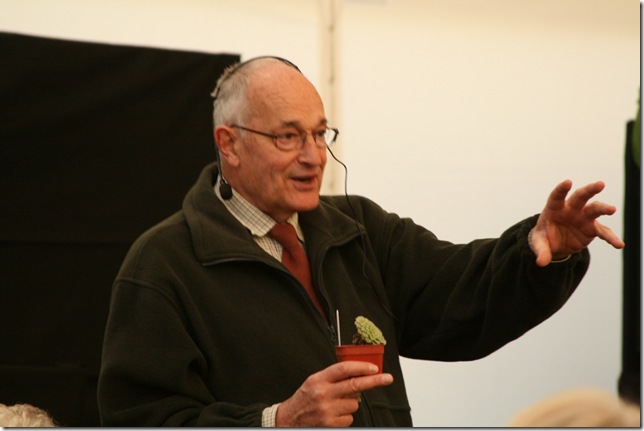
We happened across this garden blogger in the Harvest Pavilion. Here, he is explaining why he calls the plant in his hand the ‘splat plant’ (I’ve forgotten the real name of it). A very interesting talk covering a wide range of plants. I am now tempted to buy a Sarracenia or two, although I fear that having these plants in the garden will further scupper my attempt to try and introduce a little bit of unity into the garden. Oh well.

And as for the thistle to which the title of this blog post refers? Dear reader, how dare you think it refers to the gardening legend above. No, the thistle in the harvest, driving its spines into my enjoyment of the day is this creature. I think it may be some form of genetic modification experiment, crossing the heir to the throne with a poor unfortunate porcine recipient. It may be smiling, but behind that smile I can hear its sadness. But I’m sure somebody loves it – that’s the joy of gardening.IMG_7072 

For other posts from bloggers who visited Malvern this autumn, please visit VP’s Meet @ Malvern blog.

Sunday, September 26, 2010

Shampoo and Set

I feel bad that I don't like some plants. It's not their fault, after all. It's just an irrational dislike of some things over others. I suppose it's human nature. Some things press my button and will bring a grin to my face and an acquisitive itch to my palms. Others just make me cringe.

This time last year I introduced my dislike of hydrangeas. This year, I introduce a plant (or rather a flower) which causes me to press my fingernails into my palms. Or rather, just one small section of a group of plants.... exhibition chrysanthemums.

I'm not even sure it's the plants that annoy me so. It's the thought of someone spending hours primping the petals into carefully coiffed constructions. Perhaps it's the old lady analogy again - but instead of pants, this time it's a shampoo, colour and set.

IMG_7047

But I won't have a bad thing said about dahlias. I adore them. All of them.

IMG_7034

Wednesday, September 22, 2010

Tuesday, September 21, 2010

"So powerful is the light of unity that it can illuminate the whole earth"*

My first garden design lesson was last night. We learnt about the importance of unity. We examined a wide range of images of gardens (show gardens, small gardens and large, famous gardens) and looked at what gave them unity, and what elements gave discord to the scene. Such an interesting exercise, which opens your eyes. As the tutor said, we instinctively know what 'feels right' but we need to learn why we react in that way, and work out which elements bring either unity or discord. Sometimes, a little bit of discord can be a good thing - but you need to have a deep understanding of the rules before you can break them. I don't, so I couldn't.

The challenge our tutor has given us is to start looking critically at gardens and ask ourselves questions.

I look at our garden and I see discord. Oh dear. But at least now I'm beginning to understand why.

*Quotation from Bahá'u'lláh

Tuesday, September 14, 2010

Garden Bloggers’ Bloom Day Sept 2010

Last year, I was thanking Carol for giving me the opportunity to slow down and look. This year, as my job starts to speed up again, after 8 months of relative calm, I look to the garden for energy.

It's been pretty rainy the past few days, but when the sun shines, the flowers shine out, especially amongst the dappled shade of taller plants. Looking closely at the flowers in the sun is worthwhile - the flowers of the Schizostylus and Crocosmia especially scintillate and sparkle in the autumn light.

IMG_7000 IMG_6951 IMG_6954 IMG_6957 IMG_6962 IMG_6967 IMG_6974

But the plant that most captivated me in the sunshine was the tree fern – the tracery of the veins shining white against the green. Not a flower, but beautiful.

IMG_6986

Visit Carol at May Dreams Gardens for her own GBBD, and flowers from bloggers around the world.

Sunday, September 12, 2010

“Cultivate a hobby – it gives a fine pleasure to life”*

I love learning. This is a good thing, as I have a job which involves learning, and then passing on that learning in easily digestible chunks (if I’m doing it right). I’ve always loved learning. When the nights started to draw in, and mornings started to get a little bit chillier, I was pleased to be able to climb back into my uniform and go back to school. I realise that I’m lucky to have had an enjoyable learning experience throughout my life.

And so I carry on learning. The climbing back into school uniform is no longer required, but this week sees my return to college. I’ve completed half of the RHS Level 2 Certificate (the old style qualification) and return to college to complete the other half – the ‘first’ part. I really enjoyed the part I’ve just completed, which covered :

  • The Root Environment and Plant Nutrition (Flora)
  • Protected Cultivation
  • Plant Selection, Establishment and Maintenance
  • Plant Health Problems
  • It’s a theory-based qualification, but the tutors do a great deal to make it relevant to the students, and made the whole experience really enjoyable. My main triumphs after studying this half are a lawn that actually looks rather good for once (and will hopefully look even better after this autumn’s scarification, aeration, top dressing and feed), and a better understanding (and recognition) of pests and diseases.

    This semester’s topics see us studying:

  • The Plant Kingdom
  • Plant Propagation (Flora)
  • Outdoor Food Production
  • Garden Planning
  • and I’m really looking forward to propagation, as I’m not very good at this. I have to admit that I studied one year of undergraduate Botany as part of my Zoology degree, so am hoping that I might have a bit of a head start on the Plant Kingdom unit, but I’ve forgotten it all, except for some esoteric facts about plant evolution around the Cretaceous period. Probably not of much use.

    I enjoy learning theory and facts (although SomeBeans probably enjoys it less so – I think by the end of the revision session and me reciting plant names at him, he could also have passed the exam). I am less good at practical things, which is why I’m looking forward with more trepidation to a new course I’m starting tomorrow – Advanced Certificate in Garden Design. I did do a 10 week ‘leisure course’ on garden design last September and thought I’d like to take it a bit further this year. I have no illusions – I don’t have the imagination or artistic flair to take garden design further, to a career, and there are plenty of designers around without me trying to make a living at it. But  if I can improve my own garden, make useful suggestions to improve areas of my family’s gardens, and have a better understanding of what makes a good design so that I can more critically look at other gardens, then that will be enough for me. I’d like to be able to understand what history lies written in gardens, why some designs work, and why others don’t. I’m quite nervous – I love art, but had to give it up at school as I couldn’t study both art and physics. I'm not sure I’ll be very good at accurate measurements, nor at designing something that will look good and be practical. We shall see.

    And so it is back to school. And I’m very excited.

    IMG_7008 

    * Title quote is from Arthur K Bulley, creator of Ness Botanic Gardens.

    Wednesday, September 01, 2010

    Friday, August 27, 2010

    La Plum de ma Tante

    Well, actually not. I just used the title for effect, in remembrance of all of the terribly useful sentences we had to learn in French at school. ‘La Plume de ma tante’ is right up there for usefulness with ‘Le singe est dans l’arbre’. However, I digress. Anyway, the two plum trees were from my father, not my aunt.

    It has been soft fruit galore this summer at Mouffetard Towers. Brief but heavy gluts occurred in the following order: strawberries, gooseberries, raspberries and blackcurrant, and now plums. I’m assuming that three figs does not a glut make.

    We have only a small freezer, but it is stocked to the gunnels with frozen fruit. Jam has been made, as has ice cream and also plum chutney. It is with the plums that I am particularly pleased. This is the first year that they have fruited to any extent – they have only been in the ground for three years. I have been rather bad and barely thinned the fruit as they developed, which no doubt means that they will go into biannual cropping mode for a while. We have two trees – a bog standard, but ever so delicious, ‘Victoria’ and the slightly more unusual ‘Pershore Yellow Egg’. The choice of both was down to nostalgia – happy memories of shoving the sweet, soft fruits into my mouth as a child, in my grandfather’s garden. Unlike my nostalgia for rubbish 1980s bands* and for rubbish 1970s sweets, the memories have lasted the test of time.

    There cannot be a prettier fruit than a plum, particularly a pink or dark-skinned one – the soft white sheen of the bloom, the almost translucent flesh. A taste of late summer, and a taste of the turning year – colder days coming, when plum crumble will warm your soul.

    So, if you are in Worcestershire this weekend (which sadly I am not), and this post has made your mouth water for sun-warmed plum flesh, you might want to visit Pershore, home of the Pershore Plum Festival.

    DISCLAIMER: I was never very keen on Kajagoogoo but am still rather fond of a range of 80s bands, where, again, reality weighs up well against nostalgia.

    Wednesday, August 25, 2010

    Wordless Wednesday - Diamond