Friday, July 18, 2008

The Arte y Pico Award

What larks - I've been very kindly awarded the Arte y Pico award by two people. It's probably cheating, but I'll combine the thanks in a single post. Apologies for not doing so sooner, work has been horribly interfering with gardening for the past few weeks, unfortunately.

Thank you to both VP and to Emma Townshend for their nominations - it's daft, but I love my blog, so it's lovely that other people sometimes drop by to see what's going on.

Like the Oscars, there are some basic ground rules to receiving the award. Unlike the Oscars, I do not have to ponce about in a borrowed dress and loaned jewellery - just as well, because despite VP's kind comments, elegant most certainly is not a word that springs to mind. Anyway, the rules are:

1. Choose 5 blogs you consider deserving of this award for their creativity, design, interesting material, and contribution to the blogging community, regardless of the language.

2. Each award should have the name of the author and a link to his/her blog to be visited by everyone

3. Each award winner should show the award and put the name and link to the blog that presented him/her with the award.

4. The award winner and the one who has given the award should show the Arte y Pico blog so everyone will know the origin of this award.

5. Show these rules

For those of you who enjoy the feeling of prickly wool next to the skin, the Arte y Pico website has some delightful wool bikinis (just go down the page a bit). Ideal for a day on the beach at Rhyll.
So, it is with great pleasure that I pass on the award to the following bloggers, whose creations I enjoy:
  • Cote jardin - interesting, lovely photos, and also helps me improve my French.

  • James A-S for Blogging at Blackpitts - no doubt he's had many nominations, but here's one more;

  • Olives and Artichokes - plants and food, as well as sunshine - what more could you ask for?

  • The green-fingered photographer - wonderful photos, to which I aspire.

  • Pencil and Leaf - brought to my attention very recently by a post by the Garden Monkey; I am in awe of the artistry.

No obligations to carry the meme on.

Sunday, July 13, 2008

...liver, with some fava beans and a nice chianti

I've had a quite domesticated weekend. As well as using a wide range of broad bean recipes over the past couple of weeks (including a liver and broad bean risotto - hence the quote, although we had a sauvigonon blanc rather than a chianti), I've been producing fruit based puddings as if there were no tomorrow.

Firstly, strawberry cheesecake ice-cream, and today (in a bid to use up the egg whites left over after the ice cream, so as not to incur the wrath of Gordon Brown because of food wastage), raspberry pavolova. Although SomeBeans described it, rather uncharitably, as raspberry splatlova. I've never made meringue before. The 'Octavia' raspberries were delicious. As were the cream and meringue, obviously ;-)

Sunday, July 06, 2008

Violet to Blue

The human mind is a strange thing. What it chooses to remember is very fickle. Meetings, anniversaries, names - all forgotten. Obscure album tracks from albums never listened to, yet alone owned, remembered.The title to this post is the name of a Nik Kershaw (remember him? 1980's, short, fingerless gloves, big hair) album track. I read the review in Smash Hits, and remembered both the title and the story behind it (a girl called Violet dying of a drugs overdose). Now, 22 years later, I am rather tritely using it for a post about blue flowers. I've been playing with macro photography again, making use of the sunshine between the showers.
Incidentally, bumblebees (which, if you have read a previous post, are all called Delius) have a preference for blue and violet flowers, with violet being the most preferred. I like the fact that the researchers had to use 'naive' bees in their experiment.

Wednesday, July 02, 2008

Abstract


This evening, I have been experimenting with macro photography.

I'll have another practice at the weekend, if the weather is a bit better.

This plant looks beautiful even in bud - can you tell what it is?

The background is a Cercis canandensis 'Forest Pansy'

Sunday, June 29, 2008

The big green leaf


Emma at 'A nice green leaf' suggested that there be a celebration of green foliage on the last day of the month. This is a day early, which wasn't a good choice, as I've been dodging rain storms to take these photos.

Sunday, June 22, 2008

Fava nagila

Rejoicing in the bounty of the broad bean.

Broad beans are sensual plants. Their perfume is heady; the sort of smell where you just want to curl up amongst the plants and drift away into a drowse, floating on a cloud of scent, and lulled by the hum of bees.

After the perfume of the flowers has faded, there is the shelling of the pods. And what is better than breaking open the first pod of the season, and running your fingers through the silken fur inside.

Finally, as the beans become older and tougher, there is the delight of parboiling them, then slipping the tender beans out of their skins - it just feels so nice...

Today, I harvested 2.5kg of Aquadulce Claudia, with at least 10 times the amount still to pick. Last year, I planted scarlet flowered broad beans , which were a bit rubbish really - well, the flowers were gorgeous, but the harvest disappointing. This year, to make up, I've sown twice the amount, and of a much more prolific cultivar. Hence the fact that I now have around 25kg to harvest. Just as well I love the feeling of their furry little pods....

A welcome visitor

The bullfinch. A plump and plumptious birdie with a breast the colour of strawberry sorbet, gorgeously contrasting with its coal black head. If Darwin had come up with his theory of evolution whilst studying the finches of the UK rather than the Galapagos, the bullfinch would have given him the perfect example of a seed eater's bill.

We've got three visiting our garden at the moment, two males and a female, preceded by their call of 'peep'. Although they have a bit of a reputation for nibbling fruit blossom, I'd rather have bullfinches than blossom. Although, as luck would have it, they seem to prefer the seed on the bird table than my apple blossom.

Saturday, June 14, 2008

Foggie-toddlers

What a great name. Apparently, this is a Scottish name for bumblebees. According to SomeBeans, all bumblebees have the same first name, which is Delius. Why bees would have first names, and if so, why it would be Delius, he is a little hazy about.

Actually, it was only today that he realised that there were different species of bumblebee - until I suggested this, he thought that the different colourations were due to genetic variations similar to those causing different hair colour in humans. He is now in a bit of an existential quandary as to whether different species of bumblebees have different first names. Furthermore, we have been having an ongoing 'discussion' for many years as to whether bumblebees live in nests in burrows or in thick vegetation (my suggestion) or in chalets. Presumably something like this .

The National History Museum has an interactive British bumblebee key which I've been having fun playing with today. Of course, you need to make sure you're not trying to identify a mimic such as the bumblebee hoverfly instead. Hoverflies can generally be distinguished from the insects they mimic by the false wing edge vein (one of the few things I remember from my zoology degree).

Apparently, bumblebees are not doing too well in the UK at the moment, with three species already extinct according to the Bumblebee Conservation Trust. There's a lot we can do to help, by practicing bumblebee friendly gardening. It seems that they like a more 'relaxed' style of gardening (very much in the ethos of the Inelegant Gardener). The favorite plants of the foggie-toddlers in our garden are the cardoons, which seethe with the insects in summer, but they seem to like pretty much any flower, including dahlias, snapdragons, sedum, and echinacea.

All of the bumblebees in the UK belong to the genus Bombus, (meaning 'booming') although cuckoo bumblebees used to be classified in a separate genus, Psithyrus (meaning 'murmuring'). They have an interesting lifecycle, with workers on average only living for four weeks. Their behaviour is quite complex, with communication by pheremones, which are used to pass on information, including marking which flowers have been visited, so that other bumbles can avoid them.

So, say "Hello, Delius" to the next foggie-toddler you see, and do what you can to help them.


This has been a public information announcement on behalf of the Foggie-toddlers Admiration Society.

Wednesday, June 11, 2008

Floral and foliage fireworks

Although I probably say this about each of the seasons in turn, there isn't a finer time of year than early to mid summer. Young leaves still have the zing of youth, not yet maturing into the duller olive colours of late summer. Flowers are still enough of a delight after the long, dark winter to captivate you with their colours. By late July, the eyes have acclimatised to the saturation and delicious excess, and one can become blasé. But for now, there is still a thrill of excitement for each new bloom.


So, light the blue touch paper, but don't retire to a safe distance. Get up close, admire the floral fireworks. Listen to the wooshes, the fwings, and the booms, and don't be afraid to embrace the child within you and go "aaaaahhh" at the pretties...

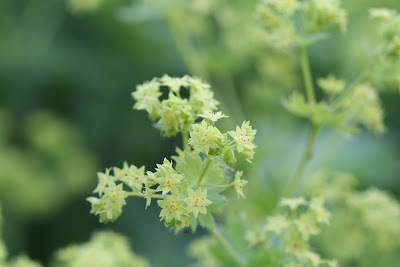
Alchemilla mollis

Allium christophii

Bougainvillea

Young fig leaf

Self-sown foxglove

Rodgersia

Osteospermum

Self sown Love-in-a-mist

Note: the Inelegant Gardener can take no responsibility for any injuries if you don't follow the floral fireworks code.

Wednesday, June 04, 2008

Je t'aime...moi non plus

Subtitle: Well, what would you have done?

SomeBeans came across this very intimate scene earlier today. Although his horticultural skills have developed such that he (a) has sole control over the houseplants (see previous post) and (b) has now planted both plug plants and seeds (although was disappointed that mature plants did not spring forth immediately from the sown seed), I was distressed to discover that the lily munching paramours were let off a death sentence.

Quite apart from the moral turpitude of capturing such an intimate act, the real shock was that he allowed the besporting beasties to continue undisturbed and unmolested. The emailed photo sent to me this morning was captioned "I couldn't kill them". Where have I gone wrong...an opportunity to smite not one of the little bu99ers but two of them at once, before they send forth their frass encrusted offspring to wreak yet more havoc on my lilies.

What would you have done?

For those lucky enough not to have encountered the lily beetle, the links below gives a profile of the pest, and explains the rather delightful habits of the larvae
http://www.rhs.org.uk/advice/profiles0500/beetle.asp
http://www.uoguelph.ca/pdc/Factsheets/Insect/LilyLeafBeetle.htm